Eliminate indoor sugar ants, destructive carpenter ants, and painful lawn fire ant mounds with colony-transfer liquid baiting and non-repellent barrier defense.
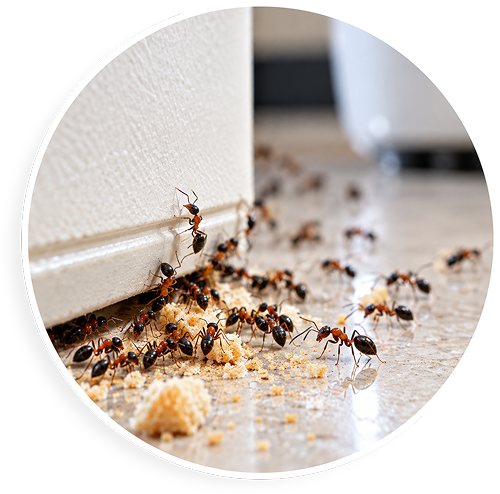
Ants are among the most persistent household invaders in America. While sugar ants (*Tapinoma sessile*) invade kitchen countertops searching for food, carpenter ants (*Camponotus*) excavate galleries in wooden studs, causing structural weakening similar to termites. Fire ants (*Solenopsis invicta*) build aggressive outdoor mounds that inflict painful stings. Service A to Z connects homeowners with certified ant control experts who deploy non-repellent transfer chemistry to destroy central queens and subterranean colonies.
Tiny black/brown ants invading kitchen sinks and pantries in long trails. Spraying DIY repellent aerosol causes "budding," splitting the colony into multiple nests.
Large black ants (up to 1/2 inch) that bore into moist framing timbers, window sills, and deck supports, leaving sawdust-like frass.
Red aggressive outdoor ants that construct raised soil mounds in lawns and deliver painful venomous stings to humans and pets.
Fast-moving microscopic ants that nest inside electrical boxes, wall voids, and potted plants, requiring specialized liquid gel matrix baiting.
Effective ant control requires feeding slow-acting, non-repellent active ingredients to worker ants so they carry the toxicant directly to the queen:
Connect directly with licensed ant exterminators for immediate inspection and scheduling.
Learn how outdoor perimeter sealing and scent-trail disruption stop foraging worker ants.
How to Prevent Ants from Entering Your Home: Foundation Sealing & Trail Disruption